
A company that sells laboratory equipment has a support team of four. They answer the same questions all day: which filter fits which model, how to recalibrate after a move, what an error code means. The answers are in six hundred pages of manuals. The sales director returns from a trade fair with an idea. An AI service could read the manuals and draft the replies.
A developer builds a demonstration in an afternoon, and it is impressive. The director asks when it can go live. The honest answer is that the afternoon covered the part that was never in doubt.
What AI integration is
AI integration means connecting an AI service, usually a language model run by another company, to systems you already have, so that it works on your information inside your own process. The model reads your documents, or drafts a reply from your records, or sorts incoming requests.
The word to hold on to is integration. A model that can write a good answer already exists and can be rented by the month. What does not exist until someone builds it is the connection: what the service is given to read, where its output goes, and what stands between that output and a customer. That is the same kind of work as joining any two systems, described in API integration, explained for the person who signs it off, with one difference that changes the questions.
The difference is that this system is sometimes wrong in a fluent, confident way, and cannot tell you when. An ordinary integration either delivers the order or fails. A language model delivers something every time.
Five questions before it goes live
These five can be asked by someone who has never used the technology, and a proposal that cannot answer them is a demonstration, not a plan.
- What may it read? Name the documents and records. Everything it can read, it can repeat. Manuals are safe to repeat. Customer files and price agreements may not be.
- What may it do? Drafting a reply for a person to send is one thing. Sending it, issuing a refund or changing a record is another. Start with the first.
- Where does your data go? The text sent to the service leaves your systems. Which company receives it, in which country, and what its terms say about keeping it.
- Who checks the output, and how? Before anything reaches a customer or a system of record, something must check it: a person, a rule, or both.
- What happens when it is wrong or unavailable? The service will be down some afternoon. The work must still be possible without it.
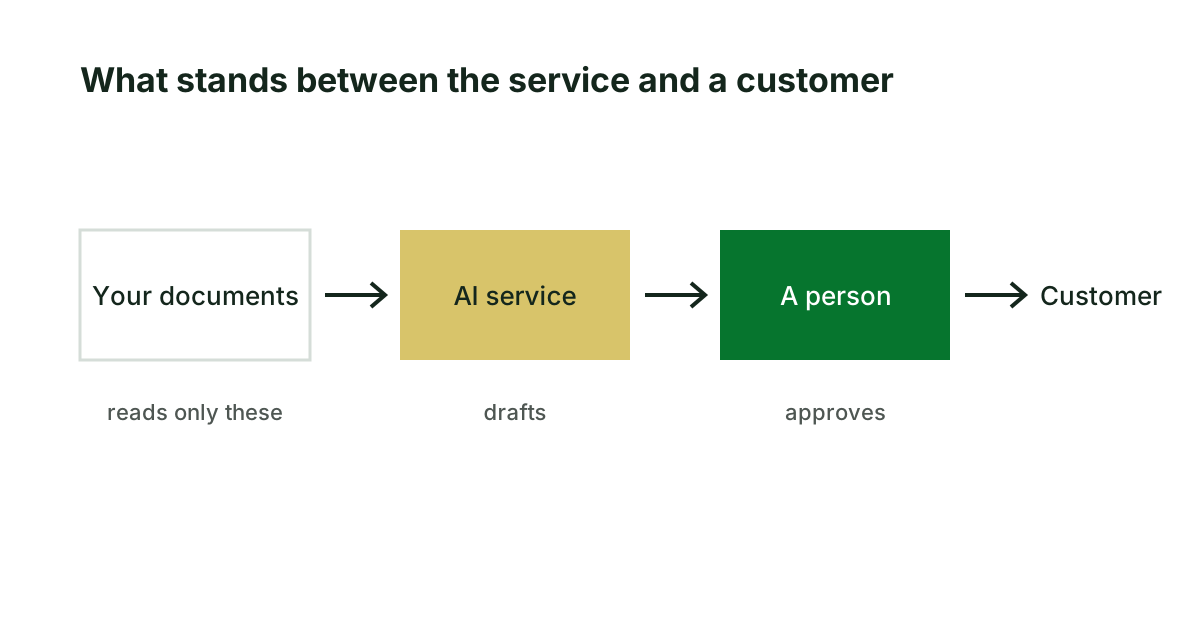
The second question has a name in the security field. The OWASP project that catalogues risks in applications built on language models calls it excessive agency, and traces it to one or more of three causes: "excessive functionality; excessive permissions; excessive autonomy". Its example is close to home. A service that reads a mailbox in order to summarise messages "may only require the ability to read emails", so it should not also be able to delete or send them. For actions that matter, its advice is to "require a human to approve high-impact actions before they are taken".
That gives a plain rule for a first project. Read only what it needs. Write nothing by itself. A person approves.
What it costs, and what it is worth
Two figures belong in any proposal, and both are missing from a demonstration.
The first is cost at your volume. AI services charge by the amount of text they read and write. One question against six hundred pages is cheap. Four hundred questions a day, each sending pages of manual with it, is a monthly bill that should be estimated before the build, from your real numbers.
The second is the measure of success, taken before anything changes. How long does a reply take today? How many are corrected after sending? Without today's figure, "faster" and "better" cannot be shown later. The same test applies to any claimed benefit of a technology project, and is set out in benefits of application modernization you can check.
The equipment company's demonstration, questioned
Back at the equipment company, an invented one, the five questions go to the demonstration.
Read: the manuals and the published error-code list. Not the customer database, which the demonstration had been connected to for convenience. Do: draft only. The draft appears in the support team's existing screen, beside the customer's question, with the manual pages it relied on shown underneath. Data: the question and the relevant manual pages go to the service; the customer's name and account number are removed first, by a rule, because the answer does not need them.
Check: a member of the team reads every draft and sends, edits or discards it. For recalibration, where a wrong instruction could damage an instrument, a rule adds a line telling the reader to confirm against the manual page shown. Wrong or unavailable: if the service does not answer within a few seconds, the screen shows the question with no draft, as it does today.
Cost: the team handles about four hundred questions a day. The developer estimates the monthly charge from a sample of two hundred real questions before building anything further. Measure: a reply takes eleven minutes on average today, and one in twenty is corrected afterwards. Both will be measured again after a month.
What goes live is smaller than the demonstration and a great deal safer. The team keeps the judgement. The service does the looking up.
Before you connect a model to your systems
- Pick one task where people spend their time looking things up in documents you already have.
- Write the answers to the five questions for that task alone.
- Take today's figures: time per item, and how often the result is corrected.
- Ask for the monthly cost at your real volume, in writing.
Connecting an AI service to your systems is integration work, and it is part of our API and systems integration service. The fixed-scope assessment that comes before any build covers what the service may read and write, where your data is sent, how its output is checked before it reaches a system of record, what it costs at your volume, and what happens when it is wrong or unavailable. It is not AI strategy or an AI readiness review.
Sources
- OWASP Gen AI Security Project, LLM06:2025 Excessive Agency, 2025.
Keep reading
Legacy application replatforming: when it is enough
Replatforming moves an application to a current platform and keeps the rest. When that is enough, when it is not, and five questions for any quote.
Process automation: what to settle before building
Automating a process as it stands keeps what is wrong with it. Four questions that pick the right process, and five things to write down before any software.
API integration, explained for the person who signs it off
What an API integration is, why sending the data is the easy half, and five things to have in writing before two systems are connected.