
A regional bus operator has a website with timetables and a journey planner. It was built five years ago by a careful team, delivered on time, and has needed almost nothing since. The operations director is proud of that. No shortcuts were taken, no corners were cut, and the maintenance budget has been close to zero.
Then a new fare zone has to be added before the summer. The quote comes back at seven weeks, with a paragraph of warnings attached. The director's first reaction is that somebody must have done something wrong. Nobody did. The site has run up a debt that no one ever decided to take on.
Debt that nobody chose
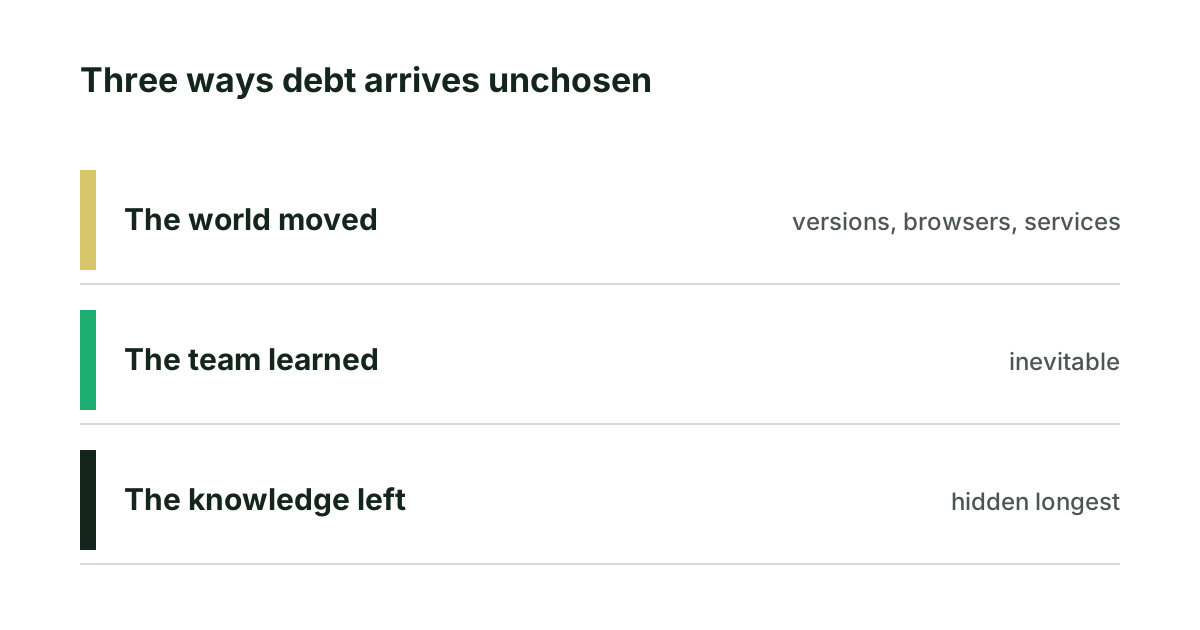
Most explanations of technical debt start with a decision: a team takes a shortcut to meet a date, and pays for it later. That kind is described in technical debt explained. A large share of the debt in any system that has been running for years was never decided at all. It arrived in three ways.
- The world moved. The platform, the language it runs on, the browsers and phones people use, the outside services the site calls: all of them changed while the site stayed still. The UK's National Cyber Security Centre describes what follows for anything no longer supported by its developer: "Over time, new vulnerabilities will be discovered that can be exploited by relatively low-skilled attackers."
- The team learned. People understand a problem better after building the solution. Martin Fowler calls the result inadvertent debt and says it is "not just common but inevitable for teams that are excellent designers": "the moment you realize what the design should have been, you also realize that you have an inadvertent debt".
- The knowledge left. The people who knew why things were done moved on. What they knew was true, useful and never written down.
The first is why a system that is left alone still falls behind. The second is unavoidable and a sign of nothing bad. The third is the one that stays hidden longest, because a system nobody understands gives no sign of it until someone has to change it.
Why it stays hidden
Chosen debt is usually known. Someone remembers the shortcut. Debt that accumulated has no moment at which anyone noticed it, and three things keep it out of sight.
- Nothing is broken. The site is up. Interest on debt is only charged when somebody asks for a change, and a system that is rarely changed is rarely charged.
- Nobody is asking. After two or three surprising quotes, people stop requesting changes. The cost falls to nothing on paper at the moment it is highest in fact.
- There is no line for it. Budgets have a line for new work and a line for hosting. The slow ageing of a working system belongs to neither.
The pattern to watch for is the one the bus operator had: a low maintenance bill for years, taken as proof of health. It can just as well be proof that nothing has been looked at.
How to find it before a deadline does
A yearly look, taking a day or two, turns hidden debt into a known list. It needs four questions and no reading of code.
- What is it standing on, and until when? Take the "versions behind" measure from measuring technical debt, and add the date support ends for each part.
- What has not been touched in two years? Parts nobody has changed are parts nobody has recently understood. List them, and mark the ones the business may need to change.
- Who could change it tomorrow? Names. If the builders have gone, ask what was handed over in writing.
- What did we stop asking for? The requests people gave up on are the best guide to where the interest is.
The answers place each item among the kinds set out in types of technical debt, and they show whether the system is drifting towards the condition described in legacy applications: what makes one, and what to ask.
What is unavoidable, and what is neglect
Debt of this kind cannot be prevented. It can be kept small, and the difference between the two is a matter of routine and not of blame.
Unavoidable: the platform will release new versions, and your team will understand the problem better next year than this year. Neglect: nobody knows which version you are on, or when its support ends. The National Cyber Security Centre puts the choice plainly. When a product becomes obsolete, "you'll need to trade off the risks from continuing to use them against the cost of replacing or upgrading them", and a decision to carry on at risk should be revisited regularly. Deciding to stay on an old version for another year, with the date written down, is management. Finding out by accident is not.
The same holds for records. Data has its own version of this debt: fields that changed meaning, entries nobody has checked since they were imported. It is covered in legacy data modernization: moving the records safely.
The bus operator asks before accepting seven weeks
The bus operator is invented; the dates it meets are typical. Before accepting seven weeks, the director asks the four questions.
Standing on: the platform is two major versions behind, and security fixes for it stopped eight months ago. The mapping service the journey planner calls has announced the end of the version the site uses. Not touched: the fare calculation, unchanged since launch. Who could change it: the original team has disbanded, and the handover was a login and a two-page note. Stopped asking: the marketing team wanted school-holiday timetables shown separately two years ago, was quoted a month, and never raised it again.
The seven weeks now make sense. Four of them are not for the fare zone. They are for understanding the fare calculation well enough to change it safely, and for the platform update the change cannot be made without. The director splits the work. The update and a written description of the fare rules are done first, as their own job. The new zone then takes two weeks, and the next fare change will take less. The ways of doing that first job are set out in reducing technical debt: what the work consists of.
A yearly look at what you stand on
- Ask the four questions about every system the business would miss within a day.
- Write the support dates in the calendar, a year ahead of each.
- For anything only one person understands, have its rules written down this quarter.
- Treat a maintenance bill of nothing as a question, not as an answer.
When the list shows a website whose platform has run out of support, the next decision is how to move it without losing the pages and addresses it has earned. Our website modernization assessment answers that for one site, before anyone commits to a rebuild.
Sources
- Martin Fowler, Technical Debt Quadrant, 2009.
- National Cyber Security Centre, Obsolete products, Device Security Guidance.
Keep reading
Reducing technical debt: what the work consists of
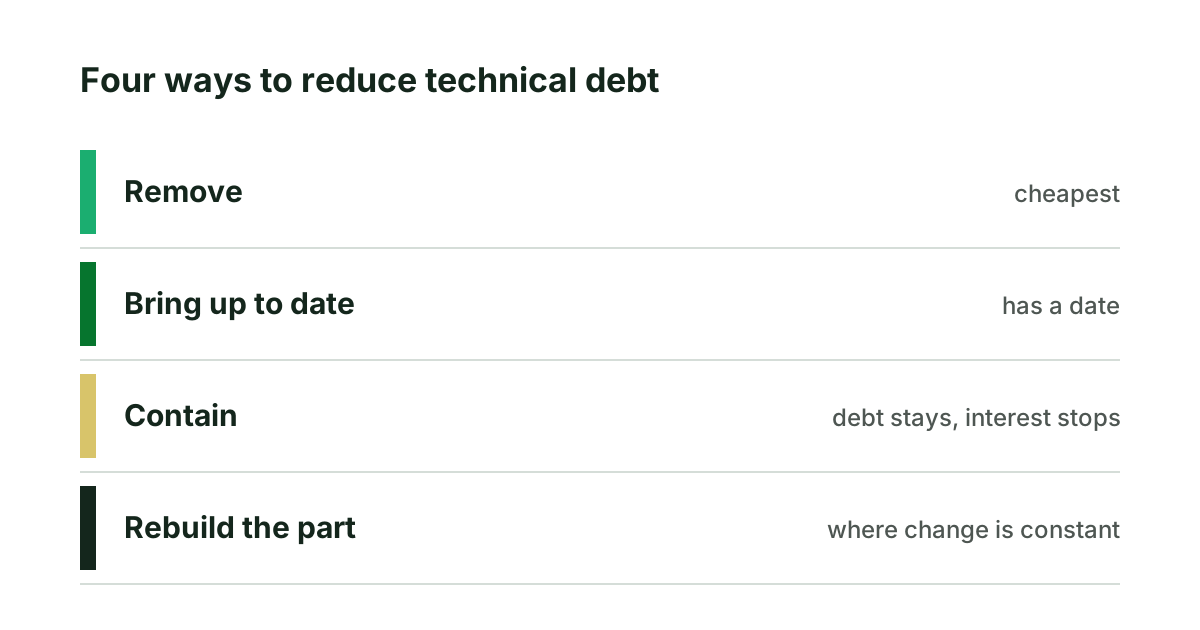
Reducing technical debt is one of four kinds of work: remove, update, contain or rebuild. What each costs, the order to do them in, and the proof to ask for.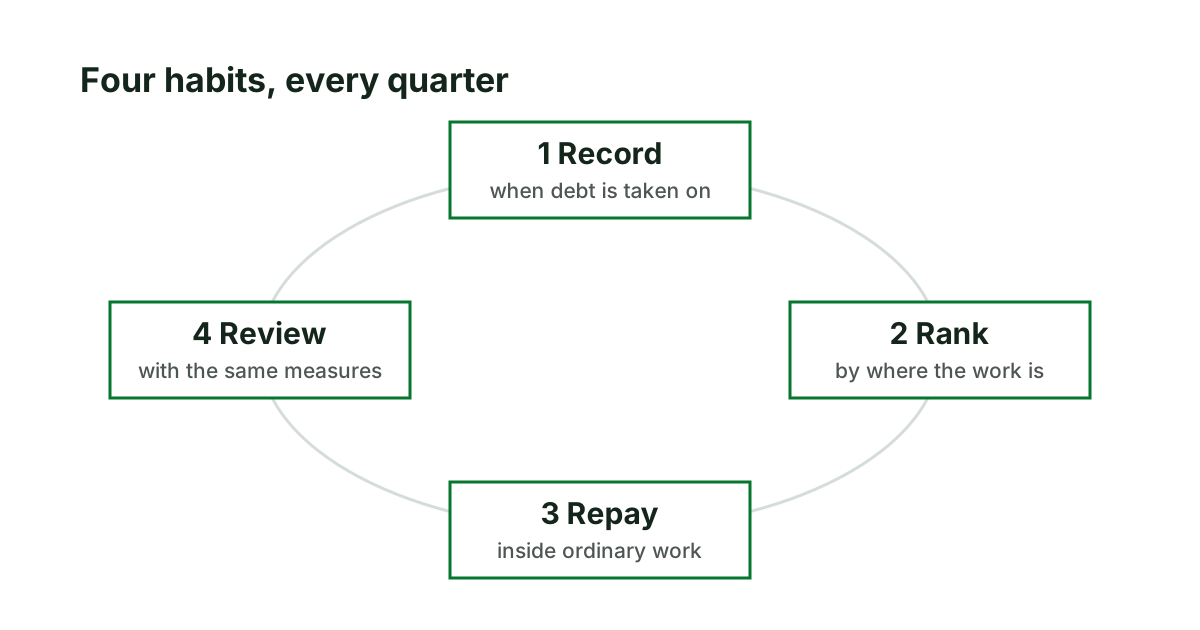
Managing technical debt as a routine, not a rescue
Clean-up projects stall because the business cannot stop for them. Four habits that keep technical debt in hand, and the decisions only the owner makes.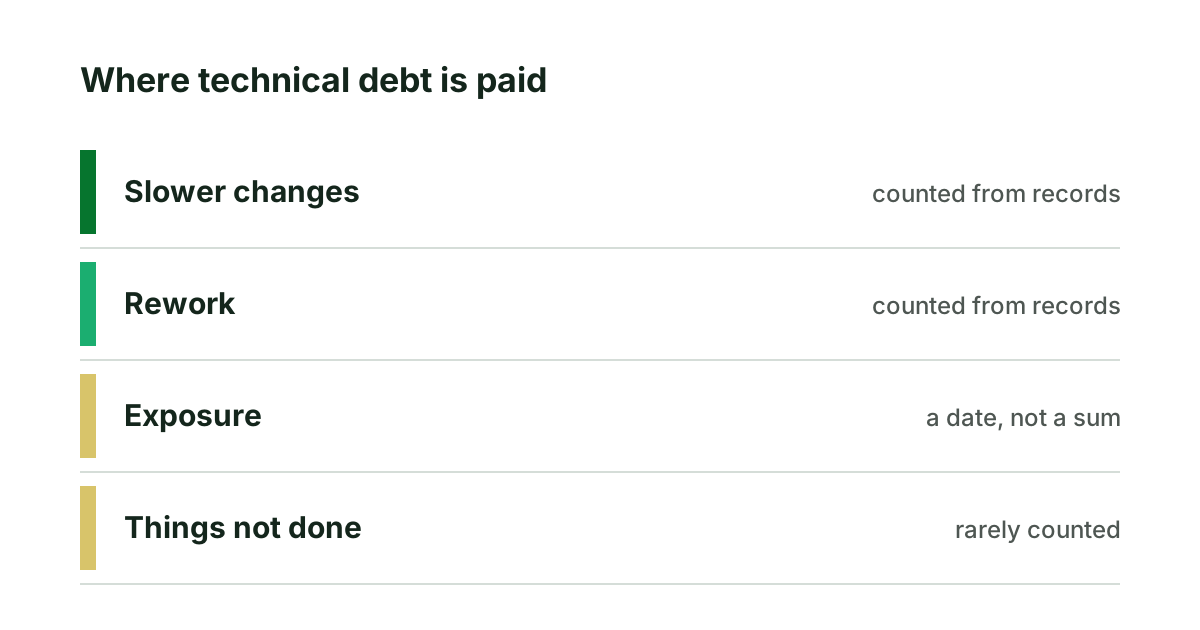
The cost of technical debt, and how to put a figure on it
Technical debt is paid in four places, and only one is near an invoice. How to build a yearly figure good enough to set beside the price of a repair.